- English
- Español
- Português
- русский
- Français
- 日本語
- Deutsch
- tiếng Việt
- Italiano
- Nederlands
- ภาษาไทย
- Polski
- 한국어
- Svenska
- magyar
- Malay
- বাংলা ভাষার
- Dansk
- Suomi
- हिन्दी
- Pilipino
- Türkçe
- Gaeilge
- العربية
- Indonesia
- Norsk
- تمل
- český
- ελληνικά
- український
- Javanese
- فارسی
- தமிழ்
- తెలుగు
- नेपाली
- Burmese
- български
- ລາວ
- Latine
- Қазақша
- Euskal
- Azərbaycan
- Slovenský jazyk
- Македонски
- Lietuvos
- Eesti Keel
- Română
- Slovenski
- मराठी
- Srpski језик

How Do Indoor LED Strip Lights Transform Residential and Commercial Lighting?
Indoor LED strip lights have rapidly become a central component in modern lighting design, offering flexible illumination for homes, offices, retail environments, studios, hospitality venues, and architectural interiors. Their slim profiles, customizable brightness levels, advanced color-tuning capabilities, and energy-efficient performance allow designers and end-users to rethink how interior spaces are lit.
Understanding Indoor LED Strip Lights and Their Core Purpose
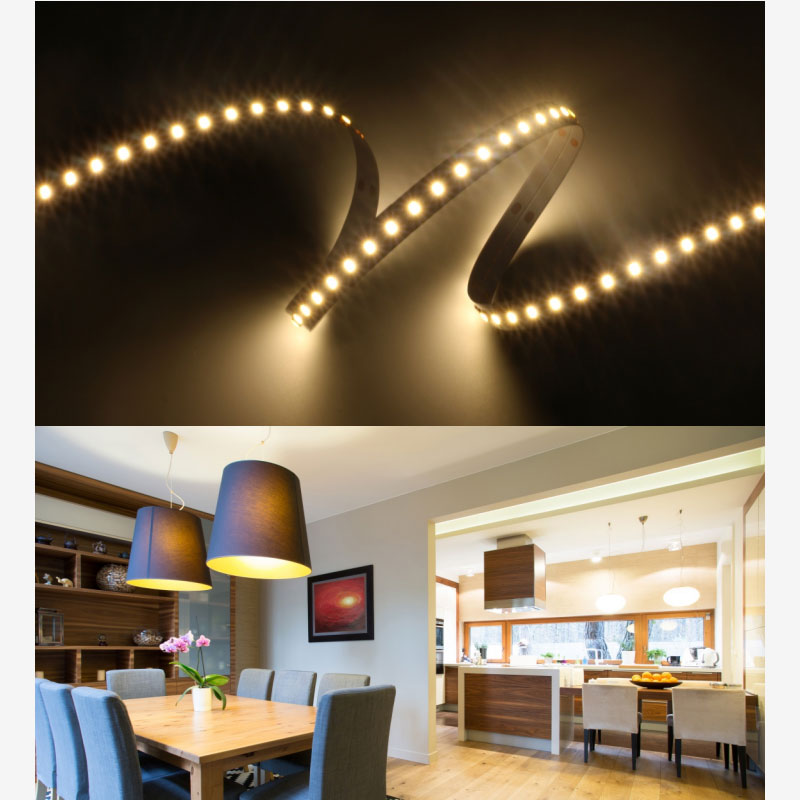
Indoor LED strip lights are linear lighting systems consisting of LEDs mounted on flexible printed circuit boards. They are engineered for versatility—capable of providing task lighting, accent lighting, ambient illumination, and decorative effects. Their adaptability makes them ideal for under-cabinet installations, cove lighting, retail displays, office design, gaming rooms, galleries, and a wide range of architectural applications.
This article provides an in-depth exploration of how indoor LED strip lights function, how their key specifications influence performance, and how they shape future lighting trends. The goal is to equip readers—whether consumers, contractors, or designers—with comprehensive knowledge about the product’s value, capabilities, and opportunities for enhancing interior spaces.
Key Product Specifications Overview
| Specification Category | Details |
|---|---|
| LED Type | SMD 2835 / 5050 / 3528 / COB (depending on application) |
| Voltage Options | 12V / 24V low-voltage configurations |
| Color Options | Single-color, tunable white (CCT 2700K–6500K), RGB, RGBW, RGBCCT |
| Brightness Range | 300–2200 lumens per meter depending on chip density |
| LED Density | 60/120/180/240 LEDs per meter or continuous COB output |
| CRI Rating | CRI 80+ / 90+ for color-accurate illumination |
| Wattage | 4W–20W per meter |
| Dimming Compatibility | PWM dimming, 0–10V dimming, smart app dimming, voice control |
| Ingress Protection | IP20 for indoor dry locations |
| Beam Angle | 120–180 degrees depending on LED chip type |
| Mounting Method | 3M adhesive backing or clip-on mounting |
| Cutting Interval | 25mm–50mm depending on LED configuration |
| Lifespan | 50,000 hours average |
These specifications collectively define how indoor LED strip lights perform in practical environments. Understanding them enables users to select the correct model for their specific lighting needs—whether demanding brightness, color quality, or energy efficiency.
How Indoor LED Strip Lights Improve Space Efficiency and Design
Indoor LED strip lights are valued not only for their visual appeal but also for their technical superiority compared to conventional lighting systems. Their combination of energy savings, flexible installation, and high customization allows them to serve both functional and decorative purposes.
1. Enhancing Lighting Quality Through High CRI and Advanced Color Output
A high Color Rendering Index (CRI) rating ensures that objects appear natural and accurate under artificial lighting. Indoor LED strips typically achieve CRI 80–90+, making them suitable for art studios, showrooms, and homes where color clarity is essential. Additionally, tunable CCT strips allow users to shift between warm, neutral, and cool tones, adapting lighting to the time of day or desired mood.
2. Reducing Energy Consumption
Indoor LED strip lights consume significantly less electricity than incandescent or halogen alternatives. Their low-voltage operation and high luminous efficacy result in lower monthly power bills and reduced environmental impact. This makes them popular for large installations such as offices, restaurants, and retail outlets that require long hours of illumination.
3. Improving Spatial Aesthetics and Architectural Integration
Because LED strips can be hidden in coves, recesses, shelves, or behind furniture, they provide a clean, modern aesthetic without visible fixtures. The seamless glow highlights architectural lines and enhances room depth. COB LED strip options provide uninterrupted light without visible spotting, ideal for premium interior design.
4. Providing Flexibility for Creative Applications
LED strip lights bend around corners, extend across long distances, and can be cut into customizable lengths. This makes them suitable for:
-
Under-cabinet kitchen lighting
-
Staircase and hallway illumination
-
Gaming desks and home studio lighting
-
Retail product highlight
-
Ceiling coves and crown molding
-
Display cases and art accents
-
Hospitality and spa environments
5. Supporting Smart and Automated Lighting Control
Modern indoor LED strip lighting systems integrate with:
-
Mobile apps
-
2.4GHz RF controllers
-
Zigbee, Z-Wave, and Wi-Fi modules
-
Voice assistants (Alexa, Google Assistant)
Users gain access to scheduling, dimming, color control, and scene presets, enhancing comfort and personalization.
How Indoor LED Strip Lights Are Expected to Evolve
The future of indoor LED strip lighting is shaped by advancements in energy efficiency, design integration, and intelligent control. Several key trends are emerging:
Trend 1: Increased Adoption of COB Technology
Chip-on-board (COB) LED strips provide continuous, dot-free illumination with higher uniformity and improved heat dissipation. They are quickly becoming the preferred choice for premium interior lighting applications.
Trend 2: Smart Home Integration as a Standard Feature
Indoor LED strip lights are expected to become fully integrated components of smart homes—synchronizing with sensors, home hubs, and automation routines. Features such as adaptive circadian lighting will become mainstream.
Trend 3: Sustainability and Ultra-Efficient LED Chips
Next-generation LED chips aim for:
-
Higher lumens per watt
-
Reduced heat output
-
Lower carbon footprint
-
Longer operational life
Materials and manufacturing processes will continue to improve in sustainability.
Trend 4: Customizable and Modular Lighting Ecosystems
Manufacturers increasingly offer modular LED strip systems with plug-and-play connectors, magnetic accessories, and interchangeable diffusers, simplifying installation for professionals and DIY users alike.
Trend 5: Architectural-Grade Design Integration
Future LED strips will be optimized for seamless integration into building structures, such as embedded channels, plaster-in profiles, and invisible mounting systems—making them essential components of architectural lighting.
Common Questions About Indoor LED Strip Lights
Below are two commonly searched questions about indoor LED strip lights, answered with clarity and practical guidance.
Q1: How long do indoor LED strip lights usually last?
A: Indoor LED strip lights typically last around 50,000 hours when used under proper voltage, ventilation, and dimming conditions. This lifespan can vary based on LED chip quality, power supply stability, and ambient temperature. High-quality strips with good heat dissipation and consistent current regulation will maintain brightness longer and degrade more slowly over time.
Q2: How can indoor LED strip lights be installed safely?
A: Safe installation requires ensuring the correct power supply voltage (12V or 24V), observing proper polarity, avoiding overloading the power adapter, and maintaining a clean mounting surface. When installing in enclosed areas, ensure adequate ventilation to prevent overheating. Using certified connectors and avoiding sharp bends will also protect the circuitry and extend the lifespan of the LED strip.
How Indoor LED Strip Lights Offer Long-Term Value and Versatile Applications
Indoor LED strip lights represent a powerful combination of energy efficiency, design freedom, and evolving smart capabilities. As residential and commercial environments increasingly adopt dynamic and adaptive lighting, these products offer unmatched flexibility for enhancing mood, functionality, and aesthetics. Their ability to provide uniform illumination, advanced color tuning, and customizable installation options makes them ideal for a wide variety of interior settings.
For businesses seeking reliable, high-performance lighting solutions, the brand Kons provides a comprehensive selection of indoor LED strip lights designed for durability, efficiency, and professional-grade illumination. With a commitment to quality and innovation, Kons continues to contribute to the advancement of lighting technology and architectural design.
For more information, project consultations, product specifications, or wholesale inquiries, contact us to explore how Kons indoor LED strip lights can elevate your next lighting project.